Showing posts with label Archaeology. Show all posts

Thursday, May 30, 2013

Posted by Anonymous | File under :
AFP Photo / Museum of Mammoth of Institute of Applied Ecology of the North North-Eastern Federak University

Russian scientists discovered a fully-grown female mammoth with blood and well-preserved muscle tissue trapped in ice in Siberia. The findings come amid debates on whether the extinct species should be resurrected using DNA.

Scientists say they have managed to find mammoth blood during the excavation of a grown female animal on the Lyakhovsky Islands, the southernmost group of the New Siberian Islands in the Arctic seas of northeastern Russia.

The dark blood was found in ice cavities below the belly of the animal. When researchers broke the cavities with a poll pick, the blood came flowing out. The fact surprised them because the temperature was 10C below zero.

“It can be assumed that the blood of mammoths had some cryo-protective properties,” said Semyon Grigoriev, head of the Museum of Mammoths of the Institute of Applied Ecology of the North at the North Eastern Federal University as cited by Interfax news agency.

The blood was placed in a test tube and a bacteriological analysis of the sample is expected soon.
The muscle tissue of the animal was also well-preserved and had a natural red color of fresh meat, added the scientist. Such preservation can be explained by the fact that the lower part of the mammoth’s body was trapped in pure ice, while the upper part was discovered in the middle of the tundra. The trunk was found separately from the carcass.

The researchers established that the female mammoth was between 50 and 60 years old when it died. Grigoriev noted that this was a unique find likely to prompt international intrigue.

The carcass of the baby mammoth, named Lyuba, found in 2007 / RIA Novosti


“We are the first in the world to find the carcass of an adult female mammoth. Now she, along with the bones and some ice, weighs about one ton. We assume that during life she weighed about three tons,” he acknowledged.

The head of the museum also suggested that the mammoth lived from 10,000 to 15,000 years ago.
Scientists have suggested that perhaps the animal fell through the ice, escaping from predators. However, its thought the predators still feasted on part of trapped mammoth.

Foreign experts are expected to see the unique mammoth material in July, according to reports.

Three adult mammoth carcasses, including the latest discovery of the Yakut scientists, have been found in the history of paleontology. However, despite such a good state of preservation, the scientists have not yet found enough living cells for cloning the species. Grigoriev noted that the repair of DNA is a very complex process that can take years.

The latest discovery and its research heralds the possibility of bringing the animal back to life in the future, though there is a lot of controversy around the issue of cloning.

A team of researchers from Russia and South Korea in September 2012 said they had discovered mammoth tissue fragments buried under meters of permafrost in eastern Siberia that could contain living cells. However the number of cells was too few to achieve successful cloning and the issue was treated with skepticism by many stem cell scientists.

Mammoths are believed to have died off around 4,000 years ago. There is dispute among scientists about the exact cause of the extinction – climate change and hunting by man are frequently cited as causes.

Source: RT

Sunday, May 5, 2013

Posted by Anonymous | File under : ,

1. Monumental Instructions for the Post-Apocalypse / The Georgia Guidestones, United States

Georgia Guidestones

On a small hill in the arid northeast region Hartwell, Georgia USA, stands the most bizarre and mysterious monuments in the world. But look at the architecture of the building, the monument was not invented in ancient times.


Known as the "Georgia Guidestones", the five stones structure has 16 feet high, weighing 20 tons.

Has four rectangular granite stone pillars that lead upwards, each pillars has the carved instructions and directions of the eighth "greatest cultural language" such as, Arabic, Cina, Russia, Inggris, Spanyol, Hindi, Hebrew and Swahili - with instructions for the human survivors of major disasters can rebuild a new civilization on this earth and not at all leave and forget the history of the ancestors.

georgia guidestones building scale details

The four pillars shaped like a plus sign and has a range of about 5 meters hence in the middle of them there is a central pillar which written Commandments on it, and then on the top of them there is a rectangular shaped granite stone.

Georgia Guidestones was build by a masonry member

On the four sides of the granite stone that was lying, there are intructions with the "language of the old culture" that has been lost from the world. And these languages ​​are Sanskrit language, Ancient Greek (Classical Greek) and Babylonian Cuneiform and Ancient Egypt (symbolic) or Egyptian Hieroglyphic.

Are the instructions in eight languages ​​associated with doomsday predictions? It is still a mystery.

The building was founded by a group of Masonic, Freemasons, Illuminati, the pagans and the supporters of other satanic groups. Read this

Looks they have made this site but on the top of the highest in the flat field are the epitome of their group.

So as if all the world and across cultures is derived, and the subject came from a single source, namely those group who want to set up a New World Order.

Proven they intend to teach this ideology, and will continue in subsequent human culture.

Georgia Guidestones depopulation conspiracyThis command is also not clear to whom addressed. More is not clear yet, who built this strange monument? There is only one person who knows but he does not want to talk.


2. Lake Michigan Stonehenge, United States

At first, a group of researchers using sonar to look for shipwrecks at the bottom of Lake Michigan, the results are quite surprising. They instead found the ancient Stonehenge-like structure 40 feet beneath the surface of the water near the Beaver Island.

Lake Michigan StonehengeMost of the stones in a circle and one appears to show carvings of a Mastodon.

Allegedly, these ancient objects was built 10,000 years ago, possibly coinciding with the post-Ice Age presence of humans and Mastodons.

Stonehenge under Lake Michigan

So in the area of ​​Michigan in the United States already has petroglyph sites and standing stones.

3. Yonaguni, Underwater Civilization Ruins, Japan

Yonaguni

On the south coast of the island of Yonaguni, Japan, there are submerged ruins, thought to have been around 8,000 years old.

This underwater ruins is also known as Yonaguni Monument Underwater Ruins.

"Though some people believed that it was carved by geographic phenomena, it’s now confirmed to be man-made as the intricate stairways, carvings and right angles suggest."
Although most people believe that it is a creation of nature, but it now appears the voices who call it man-made.


The flat parallel faces, sharp edges, and mostly right angles of the formation have led many people, including many of the underwater photographers and divers that have visited the site and some scholars, to the opinion that those features are man-made.

These people include Gary and Cecilia Hagland and Tom Holden who went on underwater expeditions to study and photograph the site as well as Dr. Sean Kingsley, a marine archaeologist. These features include a trench that has two internal 90° angles as well as the twin megaliths that appear to have been placed there. These megaliths have straight edges and square corners. However sea currents have been known to move large rocks on a regular basis.

Some of those who see the formations as being largely natural claim that they may have been modified by human hands. The semi-regular terraces of the Monument have been compared to other examples of megalithic architecture, such as the rock-hewn terraces seen at Sacsayhuaman. The formations have also been compared to the Okinawa Tomb, a rock-hewn structure of uncertain age.

Other evidence presented by those who favor an artificial origin include the two round holes (about 2 feet wide, according to photographs) on the edge of the Triangle Pool feature, and a straight row of smaller holes which have been interpreted as an abandoned attempt to split off a section of the rock by means of wedges, as in ancient quarries. Kimura believes that he has identified traces of drawings of animals and people engraved on the rocks, including a horse-like sign that he believes resembles a character from the Kaida script. Some have also interpreted a formation on the side of one of the monuments as a crude moai-like "face".

Supporters of artificial origin also argue that, while many of the features seen at Yonaguni are also seen in natural sandstone formations throughout the world, the concentration of so many peculiar formations in such a small area is highly unlikely. They also point to the relative absence of loose blocks on the flat areas of the formation, which would be expected if they were formed solely by natural erosion and fracturing.

If any part of the Monument was deliberately constructed or modified, that must have happened during the last Ice Age, when the sea level was much lower than it is today (e.g. 39 m (130 ft) lower around 10,000 years BCE).

During the Ice Age, the East China Sea was a narrow bay opening to the ocean at today's Tokara Gap. The Sea of Japan was an inland sea and there was no Yellow Sea; people and animals could walk into the Ryukyu peninsula from the continent. Therefore, Yonaguni was the southern end of a land bridge that connected it to Taiwan, Ryuyu, Japan and Asia. This fact is underscored by a rock pillar in a now-submerged cave that has been interpreted as a fused stalactite-stalagmite pair, which could only form above water.

Kimura first estimated that this must be at least 10,000 years old (8,000 BCE) dating it to a time when it would have been above water.


In a report given to the 21st Pacific Science Congress in 2007 he revised this estimate and dated it to 2,000 to 3,000 years ago as the sea level then was close to current levels.

The existence of an ancient stoneworking tradition at Yonaguni and other Ryukyu islands is demonstrated by some old tombs and several stone vessels of uncertain age.

This is evident from the composition of complex stairs, carvings which there are believed to be man-made.

This site was found in 1995 by a diver who strayed too far from the coast of Okinawa. Incidentally he also brought cameras to take pictures underwater.


4. Alexandria, Egypt

These ruins are believed to be the city of Alexander the Great, where Cleopatra's palace is located. The sinking of the city was estimated to occur 1,500 years ago due to a devastating earthquake.

alexandria

Along with the castle sinking, sinking also artifacts that adorn the palace, and other buildings of Cleopatra's palace.

City ruins discovered in the seabed, was deliberately not appointed to the mainland.

The local government plans to make the location of the ruins of magic under the sea as water attractions.


part-2 | part-3 | part-4 | part-5

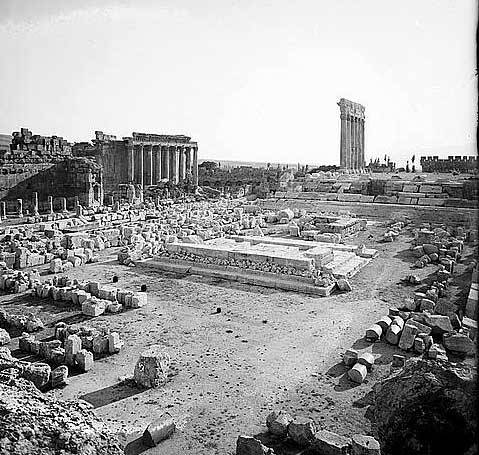
5. Mystery of Baalbek Stones, Lebanon

The largest Roman temples ever built and now only ruins, in fact, its not in Greece or Rome, but rather in Baalbek, Lebanon.

Baalbek Stones

Roman Temple named Baalbek Stone was destroyed by the Byzantine Emperor Theodosius, lucky not all parts destroyed.

There are still 6 of 54 columns, which still stands today.

Six columns here to witness history and leaving a trail of mysteries that await revealed.

Although the remains of the splendor of this temple still visible, but indeed, the temple was abandoned due to the war.

For decades, travelers rarely visit this place due to the war. Fortunately, too, the war is not to destroy this historic temple.

Wednesday, May 1, 2013

Posted by Anonymous | File under :
Heracleion City

Heracleion is a city in Egypt that shrouded by myth, even some who regard it as a fairy tale. Told that Heracleion is a legend city that has a tremendous wealth at that time. It's also mentioned in Homer that the city has visited by Helen of Troy and her lover, Paris.

In some books it's written that the city has lost in the Mediterranean Sea and buried in sand and mud for more than 1,200 years.

In the last decade, the archaeologists managed to find the bright side and prove the existence of the city with some archaeological discovery is believed to be the remains of the civilization of the city of Heracleion.

Known as Heracleion to the ancient Greeks and Thonis to ancient Egyptian the city was rediscovered in 2000 by French underwater archaeologist Dr. Franck Goddio and a teams from the European Institute for Underwater Acheology (IEASM) after a geophysical survey for four years.

Of the geographical location where the city was found, showing that Thonis-Heracleion city has linking an important international trade route. According to the Telegraph, leading research now suggests that Thonis-Heracleion served as a mandatory port of entry for trade between the Mediterranean and the Nile.

Researchers have also uncovered a variety of religious artifacts in the sunken city, including 16-foot stone sculptures thought to have adorned the city's central temple and limestone sarcophagi that are believed to have contained mummified animals. of these findings can be stated that there is the possibility of the city is a important religious center also.

Statue from Heracleion City


Statue Thonis-Heracleion
Thonis-Heracleion Statue
Thonis-Heracleion artifacts

So far, 64 ancient shipwrecks and more than 700 anchors have been unearthed from the mud of the bay. Other findings include gold coins, weights from Athens (which have never before been found at an Egyptian site) and giant tablets inscribed in ancient Greek and ancient Egyptian. Researchers think that these artifacts point to the city's prominence as a bustling trade hub.

Giant tablet from heracleion city

Experts have marveled at the variety of artifacts found and have been equally impressed by how well preserved they are.

"The archaeological evidence is simply overwhelming," Professor Sir Barry Cunliffe, a University of Oxford archeologist taking part in the excavation, said in a press release obtained by The Huffington Post. “By lying untouched and protected by sand on the sea floor for centuries they are brilliantly preserved."

A panel of experts presented their findings at an Oxford University conference on the Thonis-Heracleion excavation earlier this year.

But despite all the excitement over the excavation, one mystery about Thonis-Heracleion remains largely unsolved: Why exactly did it sink? Goddio's team suggests the weight of large buildings on the region's water-logged clay and sand soil may have caused the city to sink in the wake of an earthquake.

Here is a video documentary of the digging artifacts Heracleion City.

Saturday, April 6, 2013

Posted by Anonymous | File under :
Recently, archaeologists have been shocked by camel fossils findings in Canada, where the camel fossil found by a team of researchers at the Canadian Museum of Nature in Ottawa.

As we know that the camel is an animal that lives in the desert and dry. However, with the finding of fossils ersebut, it has been concluded that in the past, in the mid Pliosene era, ancestors of this animal was ever alive in the cold region, very close to the pole.

The fossil was discovered by a team that lead by a paleobiologist, Natalia Rybczynski, and it's found on Ellesmere Island, which is located at the far north of Canada, Nunavut. Meanwhile, the camel fossil ancestor is thought to have 3.5 million years old.

"This fossil is the first evidence showing that the camel once lived in the area," said Rybczynski to LiveScience, Tuesday (03/05/2013).

"These findings surprised us. Is why, we often associate the the camel as the animals that live in temperate habitats dry (arid) and half-dry (semi-arid), " she added.

There are 30 pieces of bone which is part shinbone of the camel fossils that have been found by the team research. The bones were then identified using collagen fingerprinting method. Total protein, named "Collagen Type I" contained in the bone were calculated.

Based on the analysis of the fossil, explained that the size of the camels at that time is 1/3 times bigger than modern camel in the present.

Rybczynski said, the conditions in the 3.5 million years ago is it possible for the camel to live in areas close to the poles.

Mid of Pliosene era was known as a warm condition. Global temperatures at the time were 2-3 degrees Celsius warmer than current temperatures.

Going forward, Rybczynski and her team plan to continue searching for the camel fossils in the area around the North Pole. "We hope to find more evidence," said Rybczynski. (The journal Nature Communications / LiveScience)